
Our Church History
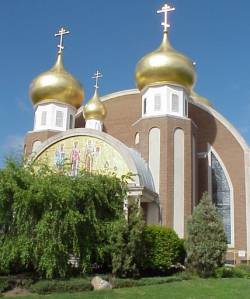
Click to Enlarge
The Russian Orthodox Church of Three Saints, the first Orthodox parish chartered in Garfield and in Bergen County, celebrated its 100th Anniversary in September of 1998.
The church was founded in 1898 by Russian immigrants, mostly from the region of the Carpathian Mountains in the former Austro-Hungarian Empire. Today’s parishioners include: first, second, and third generation families of those immigrants; converts to the faith; and recent immigrants from Russia. Named in honor of 3 fourth-century church Hierarchs, the founding of the Three Saints Church is connected to the lives of three more recent saints: Saint TIKHON (Belavin), Saint ALEXANDER Hotovitzky and Saint ALEXIS Toth.
A Patriarchal Parish of the Moscow Patriarchate, the parish today is under the pastoral care of Very Rev. George Konyev. Parish properties, business affairs, and social events are managed by the elected Church Committee, Dennis Telischack, President. The history of the Three Saints Church is shaped by the events of the parish as well as by the issues of the history of the Russian Orthodox Church in the United States.
The Centennial history of the Three Saints Church is related in two parts. The first highlights parish life from 1898 to the present. The second summarizes the history of Orthodoxy and its influences on the parish.
Three Saints Parish FOUNDING A CHURCH Beginnings: 1898-1918
From around 1860, waves of Eastern European immigrants left their war-torn and economically depressed homelands to come to America. Some sought a new life in a new country. Some expected to earn enough money to return to the homeland to improve their family’s economic conditions.
Ethnically distinct peoples of Slavic ancestry came from the Carpathian Mountain region of the former Austro-Hungarian Empire to settle North Jersey. Today the region is in Slovakia, Ukraine, Poland, Hungary, and Romania. Our ancestors from the Carpathian Mountain region were called Carpatho-Rus, Galicians, Lemkos, Ugro Rusyns, Russians, Rusyns, Slovaks, Magyars, and Ukranians. Many were Orthodox Christians; others were Roman Catholics of the Eastern Rite (Greek Catholics/Uniates).
Many people emigrated from Europe through the ports of Hamburg and Bremen, Germany, as well as through Fiume in the former Yugoslavia. Many people immigrated to the United States through Ellis Island, port of New York. Some immigrants established themselves in the industrial and textile districts of New Jersey, particularly in Garfield, Passaic, and Clifton.
The church was incorporated in 1898 under the name Russian Orthodox Greek Catholic Three Saints Society of Passaic. In 1952, the corporate name of the church was reincorporated as the Russian Orthodox Greek Catholic Three Saints Society of Garfield. In 1959, the corporate name was once again changed. The legal name of the church corporation is the Russian Orthodox Greek Catholic Church of Three Saints of Garfield. In common practice, the church is more usually known as "The Three Saints Church" or "The Three Saints Russian Orthodox Church."
Three Saints Russian Orthodox Society Branch 35
Hatala Thomas, Krayniak John, Kuchta John, Shagen Joseph Sr., Shirak John Sr., Taras Anthony and Timochko Michael.
Twenty-six families from Garfield, Clifton, Passaic, and Wallington united to build the church edifice in 1900. A site selection committee of founders recommended purchase of two city lots on the corner of Cambridge Avenue and Commerce Street. The two Garfield lots cost $475 in 1901.
Charter Members of the Three Saints Church
Hatala Thomas, Holoviak Harry, Klapp Evdokim, Koval Peter, Krayniak John, Krishko Ivan, Krynicky Conrad Kuchta John, Kurilla Yatsko, Palubniak Harry, Ruschak Wasyl, Shagen Alex, Shagen Joseph Sr., Shirak John Sr., Taras Anthony, Timochko Michael, Tyrlich Ivan, Veliky Michael, Vladyka Michael, Wolchko Elias, Yacenik Harry, Yatskanin John, Youschak Michael, Zemlansky John, Zemlansky Stephen and Zemlansky Wasil
1901 Site Selection Committee
Hatala Thomas, Krayniak John, Krynicky Conrad, Palubniak Gregory, Shagen Alex, Shagen John Sr., Shirak John Sr., Veliky Michael, Wolchko Elias and Yatskanin John The cornerstone of the Three Saints Church was laid on July 3, 1901 and blessed by Archimandrite Raphael Hawaweeny under the omophor of Bishop TIKHON (Belavin). The Archimandrite was the future Bishop of the Syro-Arabian mission and first Orthodox bishop consecrated in America. Bishop TIKHON became the Patriarch of Russia, 1917-1925. He was martyred in 1925 and than glorified with the saints in 1989. Reverend Benedict Turkevich (brother of Metropolitan LEONTY), a reader at the St. Nicholas Cathedral, participated in the ceremonies. Rev. Turkevich presided over the Russian Orthodox Mutual Aid Society as well as edited its publications.
The original Three Saints Church edifice was a wooden building adorned with traditional mural icons and a bell imported from Russia. The Reverend Fathers Alexander Hotovitzky and Elias Zotikoff of St. Nicholas Russian Orthodox Cathedral, New York City, ministered to the spiritual needs of the parish on Sundays and supervised church construction on weekdays in 1901-1902. Before their church was built, some members of the parish would travel to NYC to attend services at the St. Nicholas Church, at that time a home chapel. St. Nicholas’ Cathedral was completed in 1905.
Father Hotovitzky, Dean of the New York Cathedral, was instrumental in forming diocesan parishes throughout North America. He later returned to Moscow to become the Assistant Pastor of Christ the Savior Cathedral. Martyred in 1937 during the Communist era, Father Hotovitzky was glorified as the New Hieromartyr ALEXANDER in 1994. (Christ the Savior Cathedral, erected in gratitude to all those who had served or who had given their lives in the War of 1812, was destroyed by Stalin in 1931. The Cathedral is currently being rebuilt and restored to its original specifications in Moscow as a monument to the heroes of 1812 and to the fall of an anti-Christian, anti-religious government).
Reverend Anthony Doroschuk became the first full-time rector of the Three Saints Church from 1902-1903. Under Reverend Keiko, 1903-1904, and Reverend Olchevsky, 1904-1905, the parish grew as an increasing number of Russian Orthodox people continued to settle in the area. From 1905 to 1908, the church membership more than doubled. Reverend Peter Popoff, 1905-1908, organized the first church choir and founded a parish school. Reverend George Popoff replaced his cousin Fr. Peter Popoff as Rector, 1908-1911. The first Hierarchical Liturgy was sung when Archbishop PLATON visited the Garfield church. Archbishop PLATON had replaced Archbishop TIKHON as head of the mission in the United States in 1907. He continued missionary work among the immigrants.
Through the leadership of Reverend Michael Chervinsky, 1911-1913, a rectory was built on Commerce Street, adjacent to the church. During these years, debt was minimized. The church was consecrated by Archbishop PLATON. Reverend John Soroka led the parish from 1913-1914. He was followed byReverends Porfiry Puzanoff and Peter Salovey from 1914-1915. In 1914, a group from the Three Saints parish who lived in the Singac-Little Falls area formed the Brotherhood of St. John the Baptist. The group founded St. John the Baptist Orthodox Church in Singac in 1916.
Fire destroyed the wooden structure of the Three Saints Church on August 14, 1915. Reverend Alexander Alekhin, pastor from 1915-1917, guided the building of a larger brick church on the same site as that of the original church. Additional land adjacent to the church property was purchased. The property was used for building a parish hall and auditorium which included rooms for classes, meetings, and social functions. While the church building was under construction, church services were held at the Holy Innocents Episcopal Church. When the parish hall was completed, the hall was used temporarily for church services.
The brick, five-domed church (five domes represent Christ and the four Evangelists), completed in the fall of 1916, held its first service on December 25, 1916. Membership in the parish rapidly increased with many families coming from the towns of Clifton, Paterson, and Passaic. The parish census increased from about 100 families to more than 300 families. Two hundred of these families were members of the Fraternal Organization of the Saint Nicholas Russian Orthodox Society of Passaic, who had joined the church as one group. Some new parishioners returned to the Orthodox Church from the Greek Catholic/Uniate churches such as St. Michael’s Uniate Church in Passaic.
Reverend John Zultinoha led the Three Saints parish from 1917 to 1918 as the crucifixion of the Orthodox Church in Russia began.
From 1680 to 1873 the area that became Garfield had been a farming community settled mostly by former immigrants from Western Europe. Gradually industries developed and attracted newer immigrants from Eastern Europe and the Mediterranean in the late 1800’s and the early 1900’s. Now in 1998, Garfield as well as Bergen County continue to have a diversified population with many immigrants from Asia, Latin America, and the Caribbean. Immigrants still arrive from Russia and Eastern Europe.
The village of Garfield became the Borough of Garfield on March 15, 1898 when it separated from Saddle River Township. On April 17, 1917, the borough became the City of Garfield under the leadership of Mayor Ernest B. Danhert, grandfather of Protodeacon Daniel Sudol. Reverend Protodeacon Sudol has served the Three Saints Church parish since his ordination in 1986. The name "Garfield" was chosen in 1881 to honor the 20th President of the United States, James Garfield. The city that was named for a president hosted another president in 1992 at the site of the Three Saints Church.
Before 1887, there were no churches in the area of Garfield. The Russian Orthodox Church of the Three Saints was among the first churches built in Garfield. In 1998, there are 14 Orthodox churches in Bergen County.
Maintaining The Church - Growth: 1918-1953
Father John Telep’s guidance of the Three Saints Church for thirty three years brought spiritual and material growth to a fast developing parish. Great strides were made in completing the church’s religious art work and adornment, in educating children and adults, in organizing spiritual and fraternal societies, and in enabling the parish to become debt free. The parish expanded from being an immigrant church to a more assimilated one.
New immigrants fleeing war-torn Europe and Russia’s revolution came from diverse backgrounds (Galicians, Great Russians, Hungarians) and were drawn to the Three Saints Church. Some members of the parish were already first and second generations of immigrant families. Some families had inter-married with those of a different ethnicity and/or faith. While many parishioners spoke Rusyn and understood Church Slavonic, an increasing number of parishioners understood and spoke primarily English.
The years 1917 through the 1950s found the parish contending with the instability of relations with the Orthodox Church in Russia. The instability and poor communication were created by the events of the Russian Revolution and the rule of the Communist government. The Mother Church could no longer provide accessible leadership and spiritual guidance freely. In response, the Orthodox faithful assumed increased financial responsibilities for the parish and for the diocese. The parish also experienced a disunity within the Orthodox Church in North America when conflicts of jurisdiction and authority developed. Parishioners were anxious and confused about the status of the church hierarchy.
As he guided his local parish through troubling times, Father Telep also helped his country to understand the plight of the Orthodox Church in Russia by serving as translator at White House conferences. While affected by the turmoil in the church hierarchy, parishioners faced an economic depression and events of a nation called to wars (WW I, WW II, Korea). Sons and daughters responded to the call to military service. An increasing number of women entered the workplace. Meanwhile, parish life continued with its responsibilities to maintain the church and to provide for the education of the young.
During 1924-1925, the interior of the church was adorned with religious mural icons written by Photius Bodasiuk, an artist from Russia. The cost was $4,500. In 1926, a cellar was built beneath the church and a heating system installed at a cost of $4,500. The oak pews installed in 1930 cost $1,500. Parishioners paid $1,500 in 1930 for new roofs for the church school and rectory. The central Czechoslovakian crystal chandelier that hangs in today’s Three Saints Church was purchased for the Cambridge Avenue Church in 1934 for $1,200. In 1938, the Iconostasis and wall murals were restored (washed and repainted) by Pavel Fallat and Vladimir Gessay for $1,100. When Father Telep arrived in 1918, both the church and school buildings were heavily mortgaged. Much interior work had to be accomplished. By 1948 the renovations and repairs were made and the debt was fully liquidated.
Religious education of children and adults was a priority. Children participated in Sunday school classes for instruction in their religious and spiritual duties. The curriculum was supervised by Father Telep. Children also took Russian language lessons. Evening Bible classes were held for adults. In partnership with the Young Men’s Christian Association, English language classes were available. Father Telep prepared numerous booklets on Orthodoxy for use by parishioners. The priest inaugurated English Matins services on Sunday mornings especially for the young people. In 1948, when Professor Constantine Leontovich came to the parish, he directed the junior and senior choirs, taught beginning and advanced Russian language classes, and directed the Balalaika Orchestra Ensemble.
By 1921 there were four Brotherhood organizations affiliated with the parish: the Russian Orthodox Society of Three Saints (125 members), the St. Nicholas Russian Orthodox Beneficial Society (300 members), St. John the Baptist Brotherhood (60 members), and St. Mary’s Sorority (80 members). Over the years other organizations replaced the former groups. The Federated Russian Orthodox Clubs (FROC) known as the ‘R’ Club and the ‘Junior R Club,’ began in 1929 continues its activities to this day.
On November 8, 1925, Metropolitan PLATON consecrated the Three Saints Church and elevated Father Telep to the rank of Archpriest. Bishop ARSENY of Canada (who later founded St. Tikhon’s Seminary) offered a Hierarchical Liturgy in 1930. In the summer of 1937, the Right Reverend Archbishop VITALY, of New Jersey and Eastern US, served the Hierarchical Liturgy. On June 4, 1939, the Ruling Head of the Church in the US and Canada, His Eminence, The Most Reverend Metropolitan THEOPHILUS, served the Hierarchical Liturgy and attended a special banquet in his honor. Clergy from New Jersey, New York and Pennsylvania participated in the services. Seven hundred people attended the banquet festivities.
In 1938, parishioners of the Three Saints Church honored Father Telep, a beloved priest and friend, with a banquet to celebrate his 20th anniversary as Rector of the Church. Ten years later Father Telep resigned because of poor health.
The Very Reverend Simeon Nemetz, a graduate of St. Platon’s Russian-American Theological Seminary in Tenafly, served the parish from 1948 to 1953. Under his tenure, stained glass windows were installed, the five cupolas were refabricated, and new stainless steel crosses were erected on top of the cupolas.
In 1948, the 50th Anniversary of the Three Saints Church was celebrated. A plaque, dedicated on September 12, 1948, in memory of the founders of the church, is located on the left front porch of the nave of today’s church. The Three Saints Church had grown spiritually, materially, and educationally. Membership was strong and the parish was debt free. The first 50 years was a period of remarkable growth. The next 50 years involved relocation, expansion and development, a gradual decline of membership, and changes in Church authority.
Expansion and Building: 1953 – 1984
From 1953 to 1960, Very Reverend John Nehrebecki guided the church property improvements and acquisitions as well as expanded educational activities. The church’s brick facade was repointed and parish grounds were landscaped. The church school was remodeled at a cost of $40,000. Two houses were purchased on Commerce Street, one next to the Rectory for office space and the other as a home for the choir director. Both the church and the rectory were refurbished. In 1956, a new altar table was consecrated. The altar table now serves as a side altar in the current Three Saints Church.
In 1959, a section of the George Washington Memorial Park Cemetery in Paramus was purchased. The consecration was led by Father Dean Peter Kohanik and Fr John Nehrebecki with Orthodox clergy from the State of New Jersey participating. Later a Chapel was constructed and dedicated.
The church school enrolled 350 students in an eight-grade program of study. Each class had its own teacher. The numbers of students so taxed the limited parish hall that the parishioners rented School # 6 on Hudson Street, Garfield, to accommodate the students. A monthly parish newsletter, "The Three Saints News," was initiated and achieved national recognition as one of the best parish newspapers in the United States. Girl Scout and Boy Scout troops won many prizes in competitions in Bergen and Passaic counties.
Some members of the Three Saints Church left the parish to establish Christ the Savior Church, Paramus, in 1960. The move was reflective of expansion of Orthodox churches into the suburbs and an interest in participating in the Orthodox Church in America. The issue of establishing an independent Orthodox church in America versus the re-establishment of ties with the Mother Church was growing. The issue was decided in 1970 by a Tomos of the Orthodox Church in Russia.
When the 60th Anniversary of the Church was celebrated in 1958, the parishioners included 1,000 families. The Three Saints Church had grown to be the second largest Orthodox parish in New Jersey. The largest parish was Saints. Peter and Paul Russian Orthodox Catholicon (founded in 1902) in Passaic.
The Sunday school program required rental space. The church hall could no longer accommodate the affairs of parish social life. Youth programs were curtailed or drastically limited because of space. The church building was too small to serve the worship needs of parishioners. Parishioners decided to build a larger church and to relocate the parish to a 9 1/2 acre property at 464 Outwater Lane in Garfield, the site of the former Srob dairy farm. On 12/6/61 the land was purchased for $350,000 and the mortgage liquidated in four years. Reverend Joseph Pishtey, Jr., guided the parish from 1960 to 1969. Father Pishtey oversaw the initial building program for a larger church at a new location.
Plans for a Three Saints Church building complex included 6 buildings: church, rectory, pavilion, cultural center, choir director’s house, and annex for permanent picnic facilities. The cultural center would house: a lounge, classrooms, stage, banquet-ballroom, commercial kitchen, meeting rooms, rest rooms, administrative offices, children’s chapel, and the John Semtak Memorial Library. There would be an attached summer kitchen for picnics and a separate open pavilion for music and dancing along with storage areas for equipment and supplies. The cultural center would be available for displays, large meetings, social events, wedding receptions, and musical programs.
On June 21, 1968, the first structure of the Three Saints Complex was completed and dedicated. The structure was the annex to the cultural center. It housed the permanent picnic kitchen facilities, a refrigeration area, and rest rooms. On May 9, 1970, Reverend Igor Burdikoff, pastor from 1969 to 1978, and local clergy blessed the foundation of the cultural center. Reverend George Burdikoff, father of Father Igor, served the parish for a few months in 1969.
Four hundred thousand dollars had been allocated for the construction of the cultural center . It was completed in 1971 at a cost of $575,000. His Grace Bishop MAKARY (Svistun) blessed and dedicated the building on October 10, 1971.
Some parishioners of the Three Saints Church who desired affiliation with the growing Orthodox Church in America, left the parish to found the Eastern Orthodox Church of the Holy Apostles in Saddle Brook in 1969.The majority of the parishioners of the Three Saints Church voted in 1968 to affiliate with the Moscow Patriarchate. The affiliation decisions were difficult and painful for many of the parishioners. The issues were complex and involved the parish’s vision of its past and future, its sense of self-governance, and its concern for financial matters.
In 1969, a by lingual Divine Liturgy service was instituted. The Sunday English Matins was replaced by a Saturday Vigil service. The changes in church service were aimed at accommodating the changing needs of a parish whose membership was declining. In July 1973, the parish choir director of 19 years, Wsewolod Dudnyk, took up residence in the bi-level home constructed on the Outwater Lane property to the rear of the cultural center. Initially conceived to be the home of the choir director, the house became the rectory later. A second home has not been built.
The Church Complex was built by our own parishioner Mr. John Opuda, General Contractor. Building continued through-out the tenure of Reverend Basil Micek (1978 to 1984). By 1978 a pavilion adjacent to the picnic grove was constructed for use as a covered dance floor, refreshment area, and storage facility for supplies and heavy equipment. Church construction began in February 1982. On May 29, 1982, His Excellency Bishop IRENEY presided at the service of the founding of the new church building. Priest Basil Micek laid the foundation stone in the eastern wall of the Church. Each parishioner and friend present placed a trowelful of cement on the foundation stone as a tangible part of his or her personal participation in the building of the new church.
His Holiness PIMEN, Patriarch of Moscow and All Russia, who had come to New York City to address the General Assembly of the United Nations Organization, visited the site of the new church. He reviewed the architect’s (Lawrence S. Stern, A.I.A) plans and rendering of the Church and inspected the initial construction. His Holiness PIMEN presented the Church with an icon of Christ Pantocrator (Christ the Almighty) as a token of his love and blessing. As construction continued in 1983, His Excellency Bishop CLEMENT ceremonially tightened the final, gold-plated steel bolt of the frame work. When the concrete floor was poured, a redwood Cross that had stood in the sanctuary area since the blessing of the foundation was encased within the floor of the sanctuary where the Holy Altar would stand.
On May 14, 1984 the main cupola of the seven-cupola church and the main cross were blessed during a Molieben offered by Archpriest David Abramtsev and Priest Basil Micek. Seven cupolas symbolize the seven Ecumenical Councils that formulated the basic dogmas of the Orthodox Church. The parish choir, under the direction of Professor Michael Bondar, sang the troparia to the Holy Cross and to the Three Saints . The cross and cupola were sensed with fragrant incense and blessed by the sprinkling of holy water. The mosaic of the Three Saints, fathers of the early Orthodox Church, was already in place above the front doors of the church. It had been designed by Bruno Salvatoni of Italy. The Iconastasis had been erected. The Iconastasis wood frame was prepared by Paul Moses and the Icons written by the Studio of George Fillipakis. Fashioned in reinforced fiberglass and coated with gold leaf, the seven domes push their way toward the sky. The largest dome is 15 feet high and 24 feet in diameter, and it weighs about 5,000 pounds. A 75-foot crane set it on top of the sanctuary.
The newly constructed Three Saints Church was dedicated and consecrated on July 15, 1984. His Holiness PIMEN, Patriarch of Moscow and All Russia, gave the parish the Antimension (cloth upon which the communion sacrament is offered) and a new altar table. The Patriarch was represented by His Eminence VLADIMIR, Metropolitan of Rostov and Novocherkassk, and Bishop MAKARY. His Eminence VLADIMIR gave the Church an Antimension as well. Bishop CLEMENT, Bishop of Serpukhov, Vicar of the Patriarch of Moscow and All Russia, Administrator of Patriarchal Parishes in Canada and the USA participated in the event. About 1000 people from Garfield and its surrounding communities were on hand for the occasion, one of the biggest events in the history of Garfield.
The ceremony of dedication included the greeting and vesting of His Eminence Metropolitan VLADIMIR who led the blessing and dedication of the new church as well as the consecration of the altar. A processional moved from Outwater Lane to Cambridge Avenue to take the sacred relics from the altar of the old church. The sacred relics were carried to the new church on Outwater Lane for a consecration ceremony. A Hierarchical Divine Liturgy was served by His Eminence VLADIMIR, Metropolitan of Rostov and Novocherkassk. The Metropolitan was assisted by His Excellency MAKARY, Archbishop of Ivano-Frankovsk and Kolomisk; by His Excellency CLEMENT, Bishop of Serpukhov, Administrator of the Patriarchal Parishes in Canada and the United States; Archpriest Lev Machno, and Priest Basil Micek, Pastor of the Three Saints Church. A banquet was held in the church’s cultural center with noted clergy, city government officials, and Church Committee members as speakers. The cornerstone of the church was laid after the banquet and before further festivities.
Parishioners of the Three Saints Church gave and still give of their labors to build the $2.5-million-dollar church complex just as those parishioners had done in 1900 and 1916. Some of the names of the many contributors are memorialized on appropriate plaques at the rear of the church. Parishioners have donated icons, ikots, windows, chandeliers, candle stands and re-plated gold Eucharist objects. Many, many other volunteer their talents and time for the betterment of the parish.
Preserving The Orthodox People - Church and Community
The Three Saints Church received much public attention for very significant events. The events included a special Sunday of Orthodoxy celebration in 1986, the renaming of the church’s address, the hosting of the celebration of the Millennium, and the visit of President George Bush. In November 1991, workers from the Makarenko Studio, Yonkers, NY, installed stained-glass windows in the church. Some 1,200 square feet of glass was installed.
On Sunday, March 23, 1986, thirty Orthodox priests and deacons re-enacted the return of icons to the church, a ceremony stemming from the ninth century. The service demonstrated Orthodox unity. The gathering of clergy from Greek, Antiochan, American, Russian, and Carpatho-Rus Orthodox Churches marked the first time that so many jurisdictions of Orhodoxy had worshipped together in New Jersey. A procession commemorated the joyful march in Constantinople in 843, when Christians returned icons to the churches. The icons had been removed by those who believed the portrayal of religious figures in human form to be idolatry (iconoclasts). Some 800 people from 60 parishes in NJ, NY, and PA participated in the 90-minute service. The Sunday of Orthodoxy gave parishioners a chance to go beyond ethnic identities and to share common roots. Archpriest Sergei Suzdaltsev from St. Nicholas Cathedral, NYC, represented the Russian Patriarch and led the worship. Rev. Emil Minkovich of SS. Peter and Paul Russian Orthodox Church, Elizabeth, was homilist.
Seventeen high-ranking dignitaries from the Orthodox Church in the Soviet Union met at the Three Saints Church on April 22, 1986. The group was visiting the US at the invitation of the National Council of Churches of Christ in the US. The visit was part of a once-a-decade exchange program. The group included representatives of the Georgian Orthodox and Armenian Orthodox churches in addition to Russian Orthodox clerics. Metropolitan FILARET, a member of the group, joined Garfield’s Mayor Thomas Duch and members of the City Council to read a proclamation renaming one block of Outwater Lane as St. Vladimir’s Square. The Three Saints Church was given its own distinct address.
The Millennium, 988-1988
The Three Saints Church was selected to host the American celebration on August 13 and 14, 1988 of the Millennium of the Baptism of Kievan Rus in 988.
On Saturday (8/13) the Church sponsored exhibits, liturgical concerts, folk singing and dancing. A great Vigil was celebrated with responses sung by two church choirs. The Three Saints Church choir sang the responses in Church Slavonic; the Christ the Savior Church, Paramus, choir sang in English. On Sunday (8/14) the Russian clergy were joined by representatives of the Bulgarian Orthodox and Serbian Orthodox churches for a procession and liturgy. Religious services were conducted by Metropolitan MEFODY of Voronezh and Lipetsk, who led the delegation from the Moscow Patriarchate of the Russian Orthodox Church.
The sacred icon, "Our Lady of Pochaev" was held in a procession for the solemn Divine Liturgy commemorating the 1,000 year’s anniversary of the Russian Orthodox Church. (An exact copy of the miraculous Pochaev Icon is located in the St. Nicholas Cathedral, NYC. The original Icon dates from 1340 in Volynia--Little Russia.)
In Russia, the Millennium was celebrated in Moscow by Patriarch PIMEN as perestroika began the division of the USSR. It was the first time since 1943 that a meeting between the leader of the Orthodox church met with the leader of the Russian government. Since the Russian Revolution in 1917, some 100,000 Orthodox priests, monks, and nuns reportedly were executed or were sent to prisons and labor camps during Joseph Stalin’s purge of the church in Russia. Orthodox churches in North America and elsewhere called for the rights of the faithful of the Orthodox church in Russia. They called for the Church’s freedom from oppression, the deliverance of hundreds of prisoners of religious conscience, and the expression of the truth of the Russian tragedy to the free world.
On November 2, 1989, the Bergen County Council of Churches sponsored a banquet in honor of visiting clergy at the Three Saints Russian Orthodox Church Cultural Center. The Council served as host to members of the Presidential Board of the Christian Peace Conference during its US tour.
The visitors came from Eastern Europe, Latin America, Africa and Asia. Among the foreign visitors were: Bishop Karoly Toth, Hungarian Reformed Church and president of the Peace Conference; Metropolitan PHILARET of Kiev, the Russian Orthodox Church; Dr. Gerhard Bassarak, Evangelical Church of East Germany and former professor at Hombolt University, East Berlin; Bishop Jan Michalko, Lutheran Church of Slovakia; Dr. Lubomir Mirejovsky, Evangelical Church of the Czech Brethren; Archpriest Georgi Goncharov, Russian Orthodox Church; Rev. Christie Rosa, Anglican Church, Sri Lanka; Dr. Sergio Arce Martinez, Presbyterian Pastor and Professor at Matanzas Theological Seminary, Cuba; Professor Luis Rivera, Baptist Theological Seminary, Puerto Rico; Dr. Paulos Mar Gregorios, Metropolitan of the Syrian Orthodox Church, New Delhi, India.Given only eight days notice, the City of Garfield was informed that President George Bush would be coming to Garfield on July 21, 1992 at the invitation of former New Jersey Governor Thomas Kean. President Bush was to present his "Captive Nations Proclamation" and declare "National Freedom Day." The Three Saints Church was selected to host the President of the United States for this international event. The President spoke to a crowd of 4,000, many of whom had waited four hours for the President to arrive to give his 12-minute speech. Members of diverse ethnic groups stood in the church parking lot and waved flags of their homelands. Colombians and Ecuadorians wore native garb. Macedonians urged President Bush to support their new nation. Pakistanis, Armenians, and Poles displayed banners. Cubans and Filipinos were visible. Russian, Polish, and German music filled the time between speeches. The president stood in the shadow of the Three Saints Church’s seven golden domes surrounded by women in brightly colored ethnic costumes of more than a dozen nations. Russian Orthodox clergy joined state Republican leaders on a stage framed with a rainbow of international flags. Church bells rang as Bush took the podium. Workers from Bergen County and Garfield helped Three Saints parishioners pick-up the debris left behind by the onlookers. Garfield mayor James Krone honored the parish at the 1995 Memorial Day celebration by presenting the parish with a memorial tablet commemorating the visit of President Bush.
Under the leadership of Dr. Peter Jermihov, choir director, 1992 to 1995, a Music Society was founded. The society sponsored world-class Russian classical and folk music performances on the stage of the cultural center.
In 1994, the Three Saints Church joined in the commemoration of the Bicentennial of Orthodoxy in America. Russian missionaries had come to Alaska in 1794.
Reverend Father George Konyev arrived to minister to the Garfield parish in 1995. A native of Russia, Father Konyev received his spiritual training at the Moscow Seminary and St. Petersburg (Russia) Theological Academy. He is instrumental in encouraging recent immigrants from Russia and others to participate in the Three Saints Church parish.
On Memorial Day, 1995, the Three Saints Church celebrated the 50th anniversary of the end of World War II. The year had marked various displays of posters and pamphlets about the historical remembrance. The Sunday school children obtained an American flag that had flown over the Capitol Building in Washington, DC, for the church on this occasion. Men and women of each branch of military service and of all wars were honored at a banquet held in the cultural center. Members of the parish served their country during World War I, World War II, the Korean Conflict, the Viet Nam War, and the Gulf War. Other parishioners had served in the Russian Army or had been imprisoned as nurses in concentration and POW camps. A special tribute to those who had made the ultimate sacrifice for our country and for our freedom was led by Father George.
Today
The parish currently numbers a little over 500 people with the expectation of future growth. The parish includes families of the original charter members of the church: Palubniak, Wolchko, and Krenicki.
Subdeacon Peter Palubniak has been a reader for church services for the past 22 years. Mark Wolchko continues a family commitment to leadership on the Church Committee.
The Kenicki family offer two scholarship programs. The Paul Krenicki Memorial Scholarship Fund honors the memory of Paul Krenicki who would have been a student at Cook College in 1982. A full-tuition scholarship is awarded to a graduate of Clifton High School, New Jersey, to pursue either an undergraduate or graduate degree at Rutgers University. The Joseph and Helen Grusha Monchak Memorial Scholarship Fund supports full tuition at Rutgers University for a undergraduate or graduate student who is a member of the Three Saints Church. (Information about the scholarships is available from our Pastor Very Rev. George Konyev.
Parishioners are in the midst of renovating the church complex, since the buildings are over 25 years old. Plans have been made to further adorn the Church in the future by adding icon murals to ceiling. Designs have been offered by Russian Orthodox monks.
The church and its people are inseparable. Parishioners’ sacramental lives are documented in the church records. Below is a chart summarizing the findings available in the parish records. The earlier records are available for review from the archives of the Orthodox Church in America, Syosset, New York.
The Sunday school enrolls 67 students. Students are taught Bible history as well as prayers, and traditions. There are classes in the Russian language, Russian literature, and choir.
Parishioners are involved in diverse occupations, businesses and professions. Many have achieved higher learning and advanced degrees. An increasing number of women are in the workforce and two-income families are quite common. Many parishioners are retired and contribute their time and talents to church work.
Over the years, the membership of the Three Saints Church has fluctuated. In the early years, membership swelled because of increased immigration from Eastern Europe before World War II.
A decline in membership after the 1960’s may be attributable to relocation of families to the suburbs or other parts of the country. Many looked to join parishes closer to their new homes. Some people left the Three Saints Church to found other Orthodox churches. More recent church members of the 1990’s tend to be families of Russian immigrants. These families come to the United States for better opportunities and to connect with their religious heritage as did the immigrant founders of our church.
Our Future
Always, most important to Orthodoxy is the development of the soul of each parishioner. The spiritual life is more profound than the objects and experiences of the material world. At this, the 100th Anniversary of the Russian Orthodox Church of Three Saints, parishioners rededicate themselves to a life of harmony and integrity in accord with the teachings of Jesus Christ. We continue as missionaries to share the Orthodox faith among ourselves and others by our own words and deeds. We preserve our immigrant legacy by valuing our religious heritage, studying its precepts, and teaching its wisdom. We strive for unity within the cultural diversity of the Orthodox churches and of our broader communities.
The church was founded in 1898 by Russian immigrants, mostly from the region of the Carpathian Mountains in the former Austro-Hungarian Empire. Today’s parishioners include: first, second, and third generation families of those immigrants; converts to the faith; and recent immigrants from Russia. Named in honor of 3 fourth-century church Hierarchs, the founding of the Three Saints Church is connected to the lives of three more recent saints: Saint TIKHON (Belavin), Saint ALEXANDER Hotovitzky and Saint ALEXIS Toth.
A Patriarchal Parish of the Moscow Patriarchate, the parish today is under the pastoral care of Very Rev. George Konyev. Parish properties, business affairs, and social events are managed by the elected Church Committee, Dennis Telischack, President. The history of the Three Saints Church is shaped by the events of the parish as well as by the issues of the history of the Russian Orthodox Church in the United States.
The Centennial history of the Three Saints Church is related in two parts. The first highlights parish life from 1898 to the present. The second summarizes the history of Orthodoxy and its influences on the parish.
Three Saints Parish FOUNDING A CHURCH Beginnings: 1898-1918
From around 1860, waves of Eastern European immigrants left their war-torn and economically depressed homelands to come to America. Some sought a new life in a new country. Some expected to earn enough money to return to the homeland to improve their family’s economic conditions.
Ethnically distinct peoples of Slavic ancestry came from the Carpathian Mountain region of the former Austro-Hungarian Empire to settle North Jersey. Today the region is in Slovakia, Ukraine, Poland, Hungary, and Romania. Our ancestors from the Carpathian Mountain region were called Carpatho-Rus, Galicians, Lemkos, Ugro Rusyns, Russians, Rusyns, Slovaks, Magyars, and Ukranians. Many were Orthodox Christians; others were Roman Catholics of the Eastern Rite (Greek Catholics/Uniates).
Many people emigrated from Europe through the ports of Hamburg and Bremen, Germany, as well as through Fiume in the former Yugoslavia. Many people immigrated to the United States through Ellis Island, port of New York. Some immigrants established themselves in the industrial and textile districts of New Jersey, particularly in Garfield, Passaic, and Clifton.
The church was incorporated in 1898 under the name Russian Orthodox Greek Catholic Three Saints Society of Passaic. In 1952, the corporate name of the church was reincorporated as the Russian Orthodox Greek Catholic Three Saints Society of Garfield. In 1959, the corporate name was once again changed. The legal name of the church corporation is the Russian Orthodox Greek Catholic Church of Three Saints of Garfield. In common practice, the church is more usually known as "The Three Saints Church" or "The Three Saints Russian Orthodox Church."
- Orthodox - from the Greek word meaning "right opinion". The correct religious doctrine conforming to the Christian faith as represented by apostolic teaching and the creeds of the early church.
- Greek - indicating the language of the early church, and, the Eastern Rite ( Orthodoxy) rather than the Latin Rite ( Roman Catholicism) of Christianity.
- Catholic - from the Greek word catholikos meaning universal or according to the whole.
Three Saints Russian Orthodox Society Branch 35
Hatala Thomas, Krayniak John, Kuchta John, Shagen Joseph Sr., Shirak John Sr., Taras Anthony and Timochko Michael.
Twenty-six families from Garfield, Clifton, Passaic, and Wallington united to build the church edifice in 1900. A site selection committee of founders recommended purchase of two city lots on the corner of Cambridge Avenue and Commerce Street. The two Garfield lots cost $475 in 1901.
Charter Members of the Three Saints Church
Hatala Thomas, Holoviak Harry, Klapp Evdokim, Koval Peter, Krayniak John, Krishko Ivan, Krynicky Conrad Kuchta John, Kurilla Yatsko, Palubniak Harry, Ruschak Wasyl, Shagen Alex, Shagen Joseph Sr., Shirak John Sr., Taras Anthony, Timochko Michael, Tyrlich Ivan, Veliky Michael, Vladyka Michael, Wolchko Elias, Yacenik Harry, Yatskanin John, Youschak Michael, Zemlansky John, Zemlansky Stephen and Zemlansky Wasil
1901 Site Selection Committee
Hatala Thomas, Krayniak John, Krynicky Conrad, Palubniak Gregory, Shagen Alex, Shagen John Sr., Shirak John Sr., Veliky Michael, Wolchko Elias and Yatskanin John The cornerstone of the Three Saints Church was laid on July 3, 1901 and blessed by Archimandrite Raphael Hawaweeny under the omophor of Bishop TIKHON (Belavin). The Archimandrite was the future Bishop of the Syro-Arabian mission and first Orthodox bishop consecrated in America. Bishop TIKHON became the Patriarch of Russia, 1917-1925. He was martyred in 1925 and than glorified with the saints in 1989. Reverend Benedict Turkevich (brother of Metropolitan LEONTY), a reader at the St. Nicholas Cathedral, participated in the ceremonies. Rev. Turkevich presided over the Russian Orthodox Mutual Aid Society as well as edited its publications.
The original Three Saints Church edifice was a wooden building adorned with traditional mural icons and a bell imported from Russia. The Reverend Fathers Alexander Hotovitzky and Elias Zotikoff of St. Nicholas Russian Orthodox Cathedral, New York City, ministered to the spiritual needs of the parish on Sundays and supervised church construction on weekdays in 1901-1902. Before their church was built, some members of the parish would travel to NYC to attend services at the St. Nicholas Church, at that time a home chapel. St. Nicholas’ Cathedral was completed in 1905.
Father Hotovitzky, Dean of the New York Cathedral, was instrumental in forming diocesan parishes throughout North America. He later returned to Moscow to become the Assistant Pastor of Christ the Savior Cathedral. Martyred in 1937 during the Communist era, Father Hotovitzky was glorified as the New Hieromartyr ALEXANDER in 1994. (Christ the Savior Cathedral, erected in gratitude to all those who had served or who had given their lives in the War of 1812, was destroyed by Stalin in 1931. The Cathedral is currently being rebuilt and restored to its original specifications in Moscow as a monument to the heroes of 1812 and to the fall of an anti-Christian, anti-religious government).
Reverend Anthony Doroschuk became the first full-time rector of the Three Saints Church from 1902-1903. Under Reverend Keiko, 1903-1904, and Reverend Olchevsky, 1904-1905, the parish grew as an increasing number of Russian Orthodox people continued to settle in the area. From 1905 to 1908, the church membership more than doubled. Reverend Peter Popoff, 1905-1908, organized the first church choir and founded a parish school. Reverend George Popoff replaced his cousin Fr. Peter Popoff as Rector, 1908-1911. The first Hierarchical Liturgy was sung when Archbishop PLATON visited the Garfield church. Archbishop PLATON had replaced Archbishop TIKHON as head of the mission in the United States in 1907. He continued missionary work among the immigrants.
Through the leadership of Reverend Michael Chervinsky, 1911-1913, a rectory was built on Commerce Street, adjacent to the church. During these years, debt was minimized. The church was consecrated by Archbishop PLATON. Reverend John Soroka led the parish from 1913-1914. He was followed byReverends Porfiry Puzanoff and Peter Salovey from 1914-1915. In 1914, a group from the Three Saints parish who lived in the Singac-Little Falls area formed the Brotherhood of St. John the Baptist. The group founded St. John the Baptist Orthodox Church in Singac in 1916.
Fire destroyed the wooden structure of the Three Saints Church on August 14, 1915. Reverend Alexander Alekhin, pastor from 1915-1917, guided the building of a larger brick church on the same site as that of the original church. Additional land adjacent to the church property was purchased. The property was used for building a parish hall and auditorium which included rooms for classes, meetings, and social functions. While the church building was under construction, church services were held at the Holy Innocents Episcopal Church. When the parish hall was completed, the hall was used temporarily for church services.
The brick, five-domed church (five domes represent Christ and the four Evangelists), completed in the fall of 1916, held its first service on December 25, 1916. Membership in the parish rapidly increased with many families coming from the towns of Clifton, Paterson, and Passaic. The parish census increased from about 100 families to more than 300 families. Two hundred of these families were members of the Fraternal Organization of the Saint Nicholas Russian Orthodox Society of Passaic, who had joined the church as one group. Some new parishioners returned to the Orthodox Church from the Greek Catholic/Uniate churches such as St. Michael’s Uniate Church in Passaic.
Reverend John Zultinoha led the Three Saints parish from 1917 to 1918 as the crucifixion of the Orthodox Church in Russia began.
From 1680 to 1873 the area that became Garfield had been a farming community settled mostly by former immigrants from Western Europe. Gradually industries developed and attracted newer immigrants from Eastern Europe and the Mediterranean in the late 1800’s and the early 1900’s. Now in 1998, Garfield as well as Bergen County continue to have a diversified population with many immigrants from Asia, Latin America, and the Caribbean. Immigrants still arrive from Russia and Eastern Europe.
The village of Garfield became the Borough of Garfield on March 15, 1898 when it separated from Saddle River Township. On April 17, 1917, the borough became the City of Garfield under the leadership of Mayor Ernest B. Danhert, grandfather of Protodeacon Daniel Sudol. Reverend Protodeacon Sudol has served the Three Saints Church parish since his ordination in 1986. The name "Garfield" was chosen in 1881 to honor the 20th President of the United States, James Garfield. The city that was named for a president hosted another president in 1992 at the site of the Three Saints Church.
Before 1887, there were no churches in the area of Garfield. The Russian Orthodox Church of the Three Saints was among the first churches built in Garfield. In 1998, there are 14 Orthodox churches in Bergen County.
Maintaining The Church - Growth: 1918-1953
Father John Telep’s guidance of the Three Saints Church for thirty three years brought spiritual and material growth to a fast developing parish. Great strides were made in completing the church’s religious art work and adornment, in educating children and adults, in organizing spiritual and fraternal societies, and in enabling the parish to become debt free. The parish expanded from being an immigrant church to a more assimilated one.
New immigrants fleeing war-torn Europe and Russia’s revolution came from diverse backgrounds (Galicians, Great Russians, Hungarians) and were drawn to the Three Saints Church. Some members of the parish were already first and second generations of immigrant families. Some families had inter-married with those of a different ethnicity and/or faith. While many parishioners spoke Rusyn and understood Church Slavonic, an increasing number of parishioners understood and spoke primarily English.
The years 1917 through the 1950s found the parish contending with the instability of relations with the Orthodox Church in Russia. The instability and poor communication were created by the events of the Russian Revolution and the rule of the Communist government. The Mother Church could no longer provide accessible leadership and spiritual guidance freely. In response, the Orthodox faithful assumed increased financial responsibilities for the parish and for the diocese. The parish also experienced a disunity within the Orthodox Church in North America when conflicts of jurisdiction and authority developed. Parishioners were anxious and confused about the status of the church hierarchy.
As he guided his local parish through troubling times, Father Telep also helped his country to understand the plight of the Orthodox Church in Russia by serving as translator at White House conferences. While affected by the turmoil in the church hierarchy, parishioners faced an economic depression and events of a nation called to wars (WW I, WW II, Korea). Sons and daughters responded to the call to military service. An increasing number of women entered the workplace. Meanwhile, parish life continued with its responsibilities to maintain the church and to provide for the education of the young.
During 1924-1925, the interior of the church was adorned with religious mural icons written by Photius Bodasiuk, an artist from Russia. The cost was $4,500. In 1926, a cellar was built beneath the church and a heating system installed at a cost of $4,500. The oak pews installed in 1930 cost $1,500. Parishioners paid $1,500 in 1930 for new roofs for the church school and rectory. The central Czechoslovakian crystal chandelier that hangs in today’s Three Saints Church was purchased for the Cambridge Avenue Church in 1934 for $1,200. In 1938, the Iconostasis and wall murals were restored (washed and repainted) by Pavel Fallat and Vladimir Gessay for $1,100. When Father Telep arrived in 1918, both the church and school buildings were heavily mortgaged. Much interior work had to be accomplished. By 1948 the renovations and repairs were made and the debt was fully liquidated.
Religious education of children and adults was a priority. Children participated in Sunday school classes for instruction in their religious and spiritual duties. The curriculum was supervised by Father Telep. Children also took Russian language lessons. Evening Bible classes were held for adults. In partnership with the Young Men’s Christian Association, English language classes were available. Father Telep prepared numerous booklets on Orthodoxy for use by parishioners. The priest inaugurated English Matins services on Sunday mornings especially for the young people. In 1948, when Professor Constantine Leontovich came to the parish, he directed the junior and senior choirs, taught beginning and advanced Russian language classes, and directed the Balalaika Orchestra Ensemble.
By 1921 there were four Brotherhood organizations affiliated with the parish: the Russian Orthodox Society of Three Saints (125 members), the St. Nicholas Russian Orthodox Beneficial Society (300 members), St. John the Baptist Brotherhood (60 members), and St. Mary’s Sorority (80 members). Over the years other organizations replaced the former groups. The Federated Russian Orthodox Clubs (FROC) known as the ‘R’ Club and the ‘Junior R Club,’ began in 1929 continues its activities to this day.
On November 8, 1925, Metropolitan PLATON consecrated the Three Saints Church and elevated Father Telep to the rank of Archpriest. Bishop ARSENY of Canada (who later founded St. Tikhon’s Seminary) offered a Hierarchical Liturgy in 1930. In the summer of 1937, the Right Reverend Archbishop VITALY, of New Jersey and Eastern US, served the Hierarchical Liturgy. On June 4, 1939, the Ruling Head of the Church in the US and Canada, His Eminence, The Most Reverend Metropolitan THEOPHILUS, served the Hierarchical Liturgy and attended a special banquet in his honor. Clergy from New Jersey, New York and Pennsylvania participated in the services. Seven hundred people attended the banquet festivities.
In 1938, parishioners of the Three Saints Church honored Father Telep, a beloved priest and friend, with a banquet to celebrate his 20th anniversary as Rector of the Church. Ten years later Father Telep resigned because of poor health.
The Very Reverend Simeon Nemetz, a graduate of St. Platon’s Russian-American Theological Seminary in Tenafly, served the parish from 1948 to 1953. Under his tenure, stained glass windows were installed, the five cupolas were refabricated, and new stainless steel crosses were erected on top of the cupolas.
In 1948, the 50th Anniversary of the Three Saints Church was celebrated. A plaque, dedicated on September 12, 1948, in memory of the founders of the church, is located on the left front porch of the nave of today’s church. The Three Saints Church had grown spiritually, materially, and educationally. Membership was strong and the parish was debt free. The first 50 years was a period of remarkable growth. The next 50 years involved relocation, expansion and development, a gradual decline of membership, and changes in Church authority.
Expansion and Building: 1953 – 1984
From 1953 to 1960, Very Reverend John Nehrebecki guided the church property improvements and acquisitions as well as expanded educational activities. The church’s brick facade was repointed and parish grounds were landscaped. The church school was remodeled at a cost of $40,000. Two houses were purchased on Commerce Street, one next to the Rectory for office space and the other as a home for the choir director. Both the church and the rectory were refurbished. In 1956, a new altar table was consecrated. The altar table now serves as a side altar in the current Three Saints Church.
In 1959, a section of the George Washington Memorial Park Cemetery in Paramus was purchased. The consecration was led by Father Dean Peter Kohanik and Fr John Nehrebecki with Orthodox clergy from the State of New Jersey participating. Later a Chapel was constructed and dedicated.
The church school enrolled 350 students in an eight-grade program of study. Each class had its own teacher. The numbers of students so taxed the limited parish hall that the parishioners rented School # 6 on Hudson Street, Garfield, to accommodate the students. A monthly parish newsletter, "The Three Saints News," was initiated and achieved national recognition as one of the best parish newspapers in the United States. Girl Scout and Boy Scout troops won many prizes in competitions in Bergen and Passaic counties.
Some members of the Three Saints Church left the parish to establish Christ the Savior Church, Paramus, in 1960. The move was reflective of expansion of Orthodox churches into the suburbs and an interest in participating in the Orthodox Church in America. The issue of establishing an independent Orthodox church in America versus the re-establishment of ties with the Mother Church was growing. The issue was decided in 1970 by a Tomos of the Orthodox Church in Russia.
When the 60th Anniversary of the Church was celebrated in 1958, the parishioners included 1,000 families. The Three Saints Church had grown to be the second largest Orthodox parish in New Jersey. The largest parish was Saints. Peter and Paul Russian Orthodox Catholicon (founded in 1902) in Passaic.
The Sunday school program required rental space. The church hall could no longer accommodate the affairs of parish social life. Youth programs were curtailed or drastically limited because of space. The church building was too small to serve the worship needs of parishioners. Parishioners decided to build a larger church and to relocate the parish to a 9 1/2 acre property at 464 Outwater Lane in Garfield, the site of the former Srob dairy farm. On 12/6/61 the land was purchased for $350,000 and the mortgage liquidated in four years. Reverend Joseph Pishtey, Jr., guided the parish from 1960 to 1969. Father Pishtey oversaw the initial building program for a larger church at a new location.
Plans for a Three Saints Church building complex included 6 buildings: church, rectory, pavilion, cultural center, choir director’s house, and annex for permanent picnic facilities. The cultural center would house: a lounge, classrooms, stage, banquet-ballroom, commercial kitchen, meeting rooms, rest rooms, administrative offices, children’s chapel, and the John Semtak Memorial Library. There would be an attached summer kitchen for picnics and a separate open pavilion for music and dancing along with storage areas for equipment and supplies. The cultural center would be available for displays, large meetings, social events, wedding receptions, and musical programs.
On June 21, 1968, the first structure of the Three Saints Complex was completed and dedicated. The structure was the annex to the cultural center. It housed the permanent picnic kitchen facilities, a refrigeration area, and rest rooms. On May 9, 1970, Reverend Igor Burdikoff, pastor from 1969 to 1978, and local clergy blessed the foundation of the cultural center. Reverend George Burdikoff, father of Father Igor, served the parish for a few months in 1969.
Four hundred thousand dollars had been allocated for the construction of the cultural center . It was completed in 1971 at a cost of $575,000. His Grace Bishop MAKARY (Svistun) blessed and dedicated the building on October 10, 1971.
Some parishioners of the Three Saints Church who desired affiliation with the growing Orthodox Church in America, left the parish to found the Eastern Orthodox Church of the Holy Apostles in Saddle Brook in 1969.The majority of the parishioners of the Three Saints Church voted in 1968 to affiliate with the Moscow Patriarchate. The affiliation decisions were difficult and painful for many of the parishioners. The issues were complex and involved the parish’s vision of its past and future, its sense of self-governance, and its concern for financial matters.
In 1969, a by lingual Divine Liturgy service was instituted. The Sunday English Matins was replaced by a Saturday Vigil service. The changes in church service were aimed at accommodating the changing needs of a parish whose membership was declining. In July 1973, the parish choir director of 19 years, Wsewolod Dudnyk, took up residence in the bi-level home constructed on the Outwater Lane property to the rear of the cultural center. Initially conceived to be the home of the choir director, the house became the rectory later. A second home has not been built.
The Church Complex was built by our own parishioner Mr. John Opuda, General Contractor. Building continued through-out the tenure of Reverend Basil Micek (1978 to 1984). By 1978 a pavilion adjacent to the picnic grove was constructed for use as a covered dance floor, refreshment area, and storage facility for supplies and heavy equipment. Church construction began in February 1982. On May 29, 1982, His Excellency Bishop IRENEY presided at the service of the founding of the new church building. Priest Basil Micek laid the foundation stone in the eastern wall of the Church. Each parishioner and friend present placed a trowelful of cement on the foundation stone as a tangible part of his or her personal participation in the building of the new church.
His Holiness PIMEN, Patriarch of Moscow and All Russia, who had come to New York City to address the General Assembly of the United Nations Organization, visited the site of the new church. He reviewed the architect’s (Lawrence S. Stern, A.I.A) plans and rendering of the Church and inspected the initial construction. His Holiness PIMEN presented the Church with an icon of Christ Pantocrator (Christ the Almighty) as a token of his love and blessing. As construction continued in 1983, His Excellency Bishop CLEMENT ceremonially tightened the final, gold-plated steel bolt of the frame work. When the concrete floor was poured, a redwood Cross that had stood in the sanctuary area since the blessing of the foundation was encased within the floor of the sanctuary where the Holy Altar would stand.
On May 14, 1984 the main cupola of the seven-cupola church and the main cross were blessed during a Molieben offered by Archpriest David Abramtsev and Priest Basil Micek. Seven cupolas symbolize the seven Ecumenical Councils that formulated the basic dogmas of the Orthodox Church. The parish choir, under the direction of Professor Michael Bondar, sang the troparia to the Holy Cross and to the Three Saints . The cross and cupola were sensed with fragrant incense and blessed by the sprinkling of holy water. The mosaic of the Three Saints, fathers of the early Orthodox Church, was already in place above the front doors of the church. It had been designed by Bruno Salvatoni of Italy. The Iconastasis had been erected. The Iconastasis wood frame was prepared by Paul Moses and the Icons written by the Studio of George Fillipakis. Fashioned in reinforced fiberglass and coated with gold leaf, the seven domes push their way toward the sky. The largest dome is 15 feet high and 24 feet in diameter, and it weighs about 5,000 pounds. A 75-foot crane set it on top of the sanctuary.
The newly constructed Three Saints Church was dedicated and consecrated on July 15, 1984. His Holiness PIMEN, Patriarch of Moscow and All Russia, gave the parish the Antimension (cloth upon which the communion sacrament is offered) and a new altar table. The Patriarch was represented by His Eminence VLADIMIR, Metropolitan of Rostov and Novocherkassk, and Bishop MAKARY. His Eminence VLADIMIR gave the Church an Antimension as well. Bishop CLEMENT, Bishop of Serpukhov, Vicar of the Patriarch of Moscow and All Russia, Administrator of Patriarchal Parishes in Canada and the USA participated in the event. About 1000 people from Garfield and its surrounding communities were on hand for the occasion, one of the biggest events in the history of Garfield.
The ceremony of dedication included the greeting and vesting of His Eminence Metropolitan VLADIMIR who led the blessing and dedication of the new church as well as the consecration of the altar. A processional moved from Outwater Lane to Cambridge Avenue to take the sacred relics from the altar of the old church. The sacred relics were carried to the new church on Outwater Lane for a consecration ceremony. A Hierarchical Divine Liturgy was served by His Eminence VLADIMIR, Metropolitan of Rostov and Novocherkassk. The Metropolitan was assisted by His Excellency MAKARY, Archbishop of Ivano-Frankovsk and Kolomisk; by His Excellency CLEMENT, Bishop of Serpukhov, Administrator of the Patriarchal Parishes in Canada and the United States; Archpriest Lev Machno, and Priest Basil Micek, Pastor of the Three Saints Church. A banquet was held in the church’s cultural center with noted clergy, city government officials, and Church Committee members as speakers. The cornerstone of the church was laid after the banquet and before further festivities.
Parishioners of the Three Saints Church gave and still give of their labors to build the $2.5-million-dollar church complex just as those parishioners had done in 1900 and 1916. Some of the names of the many contributors are memorialized on appropriate plaques at the rear of the church. Parishioners have donated icons, ikots, windows, chandeliers, candle stands and re-plated gold Eucharist objects. Many, many other volunteer their talents and time for the betterment of the parish.
Preserving The Orthodox People - Church and Community
The Three Saints Church received much public attention for very significant events. The events included a special Sunday of Orthodoxy celebration in 1986, the renaming of the church’s address, the hosting of the celebration of the Millennium, and the visit of President George Bush. In November 1991, workers from the Makarenko Studio, Yonkers, NY, installed stained-glass windows in the church. Some 1,200 square feet of glass was installed.
On Sunday, March 23, 1986, thirty Orthodox priests and deacons re-enacted the return of icons to the church, a ceremony stemming from the ninth century. The service demonstrated Orthodox unity. The gathering of clergy from Greek, Antiochan, American, Russian, and Carpatho-Rus Orthodox Churches marked the first time that so many jurisdictions of Orhodoxy had worshipped together in New Jersey. A procession commemorated the joyful march in Constantinople in 843, when Christians returned icons to the churches. The icons had been removed by those who believed the portrayal of religious figures in human form to be idolatry (iconoclasts). Some 800 people from 60 parishes in NJ, NY, and PA participated in the 90-minute service. The Sunday of Orthodoxy gave parishioners a chance to go beyond ethnic identities and to share common roots. Archpriest Sergei Suzdaltsev from St. Nicholas Cathedral, NYC, represented the Russian Patriarch and led the worship. Rev. Emil Minkovich of SS. Peter and Paul Russian Orthodox Church, Elizabeth, was homilist.
Seventeen high-ranking dignitaries from the Orthodox Church in the Soviet Union met at the Three Saints Church on April 22, 1986. The group was visiting the US at the invitation of the National Council of Churches of Christ in the US. The visit was part of a once-a-decade exchange program. The group included representatives of the Georgian Orthodox and Armenian Orthodox churches in addition to Russian Orthodox clerics. Metropolitan FILARET, a member of the group, joined Garfield’s Mayor Thomas Duch and members of the City Council to read a proclamation renaming one block of Outwater Lane as St. Vladimir’s Square. The Three Saints Church was given its own distinct address.
The Millennium, 988-1988
The Three Saints Church was selected to host the American celebration on August 13 and 14, 1988 of the Millennium of the Baptism of Kievan Rus in 988.
On Saturday (8/13) the Church sponsored exhibits, liturgical concerts, folk singing and dancing. A great Vigil was celebrated with responses sung by two church choirs. The Three Saints Church choir sang the responses in Church Slavonic; the Christ the Savior Church, Paramus, choir sang in English. On Sunday (8/14) the Russian clergy were joined by representatives of the Bulgarian Orthodox and Serbian Orthodox churches for a procession and liturgy. Religious services were conducted by Metropolitan MEFODY of Voronezh and Lipetsk, who led the delegation from the Moscow Patriarchate of the Russian Orthodox Church.
The sacred icon, "Our Lady of Pochaev" was held in a procession for the solemn Divine Liturgy commemorating the 1,000 year’s anniversary of the Russian Orthodox Church. (An exact copy of the miraculous Pochaev Icon is located in the St. Nicholas Cathedral, NYC. The original Icon dates from 1340 in Volynia--Little Russia.)
In Russia, the Millennium was celebrated in Moscow by Patriarch PIMEN as perestroika began the division of the USSR. It was the first time since 1943 that a meeting between the leader of the Orthodox church met with the leader of the Russian government. Since the Russian Revolution in 1917, some 100,000 Orthodox priests, monks, and nuns reportedly were executed or were sent to prisons and labor camps during Joseph Stalin’s purge of the church in Russia. Orthodox churches in North America and elsewhere called for the rights of the faithful of the Orthodox church in Russia. They called for the Church’s freedom from oppression, the deliverance of hundreds of prisoners of religious conscience, and the expression of the truth of the Russian tragedy to the free world.
On November 2, 1989, the Bergen County Council of Churches sponsored a banquet in honor of visiting clergy at the Three Saints Russian Orthodox Church Cultural Center. The Council served as host to members of the Presidential Board of the Christian Peace Conference during its US tour.
The visitors came from Eastern Europe, Latin America, Africa and Asia. Among the foreign visitors were: Bishop Karoly Toth, Hungarian Reformed Church and president of the Peace Conference; Metropolitan PHILARET of Kiev, the Russian Orthodox Church; Dr. Gerhard Bassarak, Evangelical Church of East Germany and former professor at Hombolt University, East Berlin; Bishop Jan Michalko, Lutheran Church of Slovakia; Dr. Lubomir Mirejovsky, Evangelical Church of the Czech Brethren; Archpriest Georgi Goncharov, Russian Orthodox Church; Rev. Christie Rosa, Anglican Church, Sri Lanka; Dr. Sergio Arce Martinez, Presbyterian Pastor and Professor at Matanzas Theological Seminary, Cuba; Professor Luis Rivera, Baptist Theological Seminary, Puerto Rico; Dr. Paulos Mar Gregorios, Metropolitan of the Syrian Orthodox Church, New Delhi, India.Given only eight days notice, the City of Garfield was informed that President George Bush would be coming to Garfield on July 21, 1992 at the invitation of former New Jersey Governor Thomas Kean. President Bush was to present his "Captive Nations Proclamation" and declare "National Freedom Day." The Three Saints Church was selected to host the President of the United States for this international event. The President spoke to a crowd of 4,000, many of whom had waited four hours for the President to arrive to give his 12-minute speech. Members of diverse ethnic groups stood in the church parking lot and waved flags of their homelands. Colombians and Ecuadorians wore native garb. Macedonians urged President Bush to support their new nation. Pakistanis, Armenians, and Poles displayed banners. Cubans and Filipinos were visible. Russian, Polish, and German music filled the time between speeches. The president stood in the shadow of the Three Saints Church’s seven golden domes surrounded by women in brightly colored ethnic costumes of more than a dozen nations. Russian Orthodox clergy joined state Republican leaders on a stage framed with a rainbow of international flags. Church bells rang as Bush took the podium. Workers from Bergen County and Garfield helped Three Saints parishioners pick-up the debris left behind by the onlookers. Garfield mayor James Krone honored the parish at the 1995 Memorial Day celebration by presenting the parish with a memorial tablet commemorating the visit of President Bush.
Under the leadership of Dr. Peter Jermihov, choir director, 1992 to 1995, a Music Society was founded. The society sponsored world-class Russian classical and folk music performances on the stage of the cultural center.
In 1994, the Three Saints Church joined in the commemoration of the Bicentennial of Orthodoxy in America. Russian missionaries had come to Alaska in 1794.
Reverend Father George Konyev arrived to minister to the Garfield parish in 1995. A native of Russia, Father Konyev received his spiritual training at the Moscow Seminary and St. Petersburg (Russia) Theological Academy. He is instrumental in encouraging recent immigrants from Russia and others to participate in the Three Saints Church parish.
On Memorial Day, 1995, the Three Saints Church celebrated the 50th anniversary of the end of World War II. The year had marked various displays of posters and pamphlets about the historical remembrance. The Sunday school children obtained an American flag that had flown over the Capitol Building in Washington, DC, for the church on this occasion. Men and women of each branch of military service and of all wars were honored at a banquet held in the cultural center. Members of the parish served their country during World War I, World War II, the Korean Conflict, the Viet Nam War, and the Gulf War. Other parishioners had served in the Russian Army or had been imprisoned as nurses in concentration and POW camps. A special tribute to those who had made the ultimate sacrifice for our country and for our freedom was led by Father George.
Today
The parish currently numbers a little over 500 people with the expectation of future growth. The parish includes families of the original charter members of the church: Palubniak, Wolchko, and Krenicki.
Subdeacon Peter Palubniak has been a reader for church services for the past 22 years. Mark Wolchko continues a family commitment to leadership on the Church Committee.
The Kenicki family offer two scholarship programs. The Paul Krenicki Memorial Scholarship Fund honors the memory of Paul Krenicki who would have been a student at Cook College in 1982. A full-tuition scholarship is awarded to a graduate of Clifton High School, New Jersey, to pursue either an undergraduate or graduate degree at Rutgers University. The Joseph and Helen Grusha Monchak Memorial Scholarship Fund supports full tuition at Rutgers University for a undergraduate or graduate student who is a member of the Three Saints Church. (Information about the scholarships is available from our Pastor Very Rev. George Konyev.
Parishioners are in the midst of renovating the church complex, since the buildings are over 25 years old. Plans have been made to further adorn the Church in the future by adding icon murals to ceiling. Designs have been offered by Russian Orthodox monks.
The church and its people are inseparable. Parishioners’ sacramental lives are documented in the church records. Below is a chart summarizing the findings available in the parish records. The earlier records are available for review from the archives of the Orthodox Church in America, Syosset, New York.
The Sunday school enrolls 67 students. Students are taught Bible history as well as prayers, and traditions. There are classes in the Russian language, Russian literature, and choir.
Parishioners are involved in diverse occupations, businesses and professions. Many have achieved higher learning and advanced degrees. An increasing number of women are in the workforce and two-income families are quite common. Many parishioners are retired and contribute their time and talents to church work.
Over the years, the membership of the Three Saints Church has fluctuated. In the early years, membership swelled because of increased immigration from Eastern Europe before World War II.
A decline in membership after the 1960’s may be attributable to relocation of families to the suburbs or other parts of the country. Many looked to join parishes closer to their new homes. Some people left the Three Saints Church to found other Orthodox churches. More recent church members of the 1990’s tend to be families of Russian immigrants. These families come to the United States for better opportunities and to connect with their religious heritage as did the immigrant founders of our church.
Our Future
Always, most important to Orthodoxy is the development of the soul of each parishioner. The spiritual life is more profound than the objects and experiences of the material world. At this, the 100th Anniversary of the Russian Orthodox Church of Three Saints, parishioners rededicate themselves to a life of harmony and integrity in accord with the teachings of Jesus Christ. We continue as missionaries to share the Orthodox faith among ourselves and others by our own words and deeds. We preserve our immigrant legacy by valuing our religious heritage, studying its precepts, and teaching its wisdom. We strive for unity within the cultural diversity of the Orthodox churches and of our broader communities.