
Pentecost
click to enlarge
The Birthday of the Church
The feast of the Holy Trinity (otherwise, Pentecost) is dedicated to the descent of the Holy Spirit upon the Apostles on the fiftieth day after the Resurrection of Christ. This event brought into existence the Church of Christ and gave rise to the Christian faith on earth. On the feast of Pentecost the Church brings its children to the doors of its spiritual life and appeals to them to renew and strengthen in themselves the gifts of the Holy Spirit given to them in Baptism. Spiritual life of an individual is impossible without God's grace, which possesses the mysterious power of rebirth and transforms the whole of the Christian's inward life. However lofty and valuable his desire might be, it will be fulfilled by the Holy Spirit. That is why the feast of Pentecost is always so joyfully celebrated by Orthodox Christians.
Throughout all of history God gradually revealed himself to mankind. During Old Testament times people knew only about God the Father. Since the birth of the Savior they learned of his Only-begotten Son, and on the day of the descent of the Holy Spirit people learned of the existence of the Third Person of the Holy Trinity. Thus mankind was instructed to believe and praise God, one in essence and Threefold in Persons, that is, God the Father, and the Son, and the Holy Spirit, the Trinity one and indivisible.
In this pamphlet we will describe the descent of the Holy Spirit upon the Apostles, account for the importance of God's grace in Christian life and recount the service of Pentecost. We will include the canon of the Matins service and give the Orthodox treatment of the contemporary "gift of tongues." The appendix contains selected prayers of the Pentecostal Vespers service.
The Descent of the Holy Spirit
The descent of the Holy Spirit upon the Apostles on the day of Pentecost is described by the Evangelist Luke in the initial chapters of his book "Acts of the Holy Apostles." It was God's will to make this event a turning point in the world's history.
Pentecost, celebrated on the fiftieth day after the Jewish Passover, was one of the three major holidays of the Old Testament. Pentecost marked the adoption of Sinai's legislation under the Prophet Moses when the Jewish people were liberated from Egypt and entered into alliance with God nearly fourteen hundred years before Christ's birth. At that time the Jews promised to be obedient to God and He, in turn, promised them His mercy and blessings. Because the feast of Pentecost coincided with the end of the harvest season, it was celebrated with great joy. Many Jews scattered over various parts of the vast Roman empire hurried to Jerusalem to participate in this feast. Having been born and having grown up in different countries, most of them could hardly understand their mother tongue. They made an effort, however, to observe their national and religious traditions and, at least from time to time, to go on a pilgrimage to Jerusalem.
The descent of the Holy Spirit was not an unexpected event for the Apostles. As far back as a few centuries before the Savior's birth God began to prepare people for the day of their spiritual rebirth. He promised through his prophets: "It shall come to pass afterward, that I shall pour out My Spirit on all flesh ... With joy you will draw water from the well of salvation ... For I will pour water on the thirsty land, and streams on the dry ground ... A new heart I will give you, and a new spirit I will put within you; and I will take out of your flesh the heart of stone, and give you a heart of flesh. And I will put My Spirit within you, and cause you to walk in My statutes and observe and carry out My judgements" (Joel 2: 28; Is. 12: 3, 44:3; Ezek. 11:19-20).
When preparing to return to His heavenly Father, the Lord Jesus Christ in His farewell talk informed the Apostles about the forthcoming descent of the Holy Spirit. He explained to the disciples that the Comforter, that is, the Holy Spirit, would come soon to them to fulfill the mission of salvation: "I will ask the Father, and He will give you another Comforter, to be with you forever, the Spirit of Truth ... He will teach you everything and remind you of everything that I say unto you ... He, the Spirit of Truth, which proceeds from the Father, will bear witness of Me" (John 14: 16-17, 26; 15: 26).
After the events of outrage, death and resurrection of the Lord Jesus Christ, which the Apostles took deeply to their hearts, they became quite different people. They grew stronger spiritually and matured to accept the gifts of the Holy Spirit. It was then that God's mercy came to them in its fullness and they were the first to enjoy the spiritual fruits of the salutary feat of the God-Man.
Fifty days after the Resurrection of Jesus Christ and ten days after His Ascension to Heaven, the disciples of Jesus, together with the Blessed Virgin Mary, some of the pious women and other believers, 120 persons in all, gathered in Jerusalem in a so-called "Zion chamber." They were probably in the same room where the Lord, not long before His sufferings, performed the Last Supper. The Apostles were awaiting the fulfillment of the Savior's will to send them "the Father's Promise" and strengthen them with divine power, although they did not understand yet exactly what that meant.
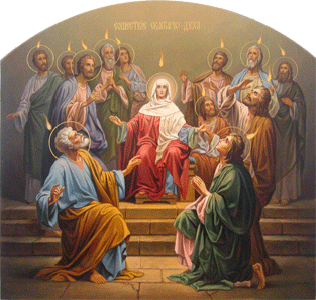
Then, at nine in the morning, when people usually came to the Temple for sacrifices and prayers, a noise came from heaven like a strong gust of wind. It filled the house, and at the same instant there appeared above the Apostle's heads what appeared to be tongues of flame which began descending on their heads. These tongues possessed a peculiar property to give light and not burn. But still more unusual were the special gifts they imparted. Everyone upon whom they descended became spiritually enriched and felt an ineffable joy and inspiration. They would begin to perceive themselves to be quite different people: pacific, full of life and a strong love for God. These innermost feelings before unknown were expressed by the Apostles through joyful exclamations and glorifications of God. It turned out that now they were not speaking their native Hebrew language but other tongues unknown to them. In that way the Apostles were baptized with the Holy Spirit and fire just as it was prophesied by John the Baptist.
Meanwhile, this sound, as if from a mighty wind, drew lots of people to the Apostles' house. Having seen people gathering from everywhere, the Apostles, rendering gratitude and praises to Almighty God in their prayers, appeared on the balcony of the house. On hearing the prayers, all those gathered around the house were amazed by the event, which was utterly incomprehensible to them. Christ's disciples, mostly Galilean in origin, had little education and were not expected to speak tongues other than their own. But now, after the miracle, they were speaking many foreign languages so that, however diverse the crowd of people might be (for they came to Jerusalem from different countries), they all heard their native tongues. There happened to be some cynics among the crowd who laughed at godly preachers and dared to say that the Apostles had become drunk from wine. But in reality the power of the Holy Spirit, besides other inner favorable changes, was being revealed by the extraordinary gift of tongues so that the Apostles would be able to propagate the Gospel more successfully among different nations without the need to learn foreign languages.
Having seen the people's perplexity the Apostle Peter came forward to deliver his first sermon. He explained to them that in the wonderful event of the descent of the Holy Spirit there came true an ancient prophecy of Joel which spoke on behalf of God: "And it shall come to pass in the last days, said the Lord, that I will pour out My Spirit on all flesh; your sons and daughters shall prophesy, your old men shall dream dreams and your young men shall see visions. Even upon My menservants and maidservants of those days, I will pour out my Spirit; and wonders will be seen in heaven above and on the earth below ... " (Joel 2: 28-32). The Apostle Peter explained that through this very event there had been achieved the great feat of the salvation of mankind. It was for their sake that the Messiah, the Lord Jesus Christ, came to them, underwent crucifixion and was resurrected. However short and simple this sermon was, it penetrated into the hearts of the listeners for it was the Holy Spirit who spoke by Peter's mouth.
Most of the people who were listening to Saint Peter were touched deeply in their souls, and they asked him, "What shall we do now?" "Repent," was Peter's answer, "and be baptized every one of you in the name of Jesus Christ for the forgiveness of your sins and receiving the gift of the Holy Spirit." Many of them came to believe in Christ after the words of Peter, repented publicly their sins and were baptized. So by the evening of the same day the Christian Church increased from 120 to 3000 believers. This miraculous event gave rise to the existence of the Christian Church, the blessed community of believers summoned to save their souls. Jesus Christ promised that His Church would be invincible against the gates of Hell until the very end of the existence of the world.
It did not occur by chance that two very important events took place on the same day: the descent of the Holy Spirit and the Jewish Pentecost. The traditional feast of Pentecost marked the alliance of the Jewish people with God. This alliance required the observation of the Ten Commandments and promised the reception of earthly blessings. The descent of the Holy Spirit implemented a completely novel and much deeper alliance, or Testament, between God and the New Israel - the Christian people. It is based on faith in the Savior and its goal is the spiritual renewal and inheritance of eternal life. The descent of the Holy Spirit has become the day on which the old theocracy, which ruled society through a rigorous law, became replaced by grace and sincere love for God. Now the Spirit of Truth became the guide of believers for their journey to Heaven, and the source of their spiritual freedom and inspiration.
by Bishop Alexander (Mileant)
The feast of the Holy Trinity (otherwise, Pentecost) is dedicated to the descent of the Holy Spirit upon the Apostles on the fiftieth day after the Resurrection of Christ. This event brought into existence the Church of Christ and gave rise to the Christian faith on earth. On the feast of Pentecost the Church brings its children to the doors of its spiritual life and appeals to them to renew and strengthen in themselves the gifts of the Holy Spirit given to them in Baptism. Spiritual life of an individual is impossible without God's grace, which possesses the mysterious power of rebirth and transforms the whole of the Christian's inward life. However lofty and valuable his desire might be, it will be fulfilled by the Holy Spirit. That is why the feast of Pentecost is always so joyfully celebrated by Orthodox Christians.
Throughout all of history God gradually revealed himself to mankind. During Old Testament times people knew only about God the Father. Since the birth of the Savior they learned of his Only-begotten Son, and on the day of the descent of the Holy Spirit people learned of the existence of the Third Person of the Holy Trinity. Thus mankind was instructed to believe and praise God, one in essence and Threefold in Persons, that is, God the Father, and the Son, and the Holy Spirit, the Trinity one and indivisible.
In this pamphlet we will describe the descent of the Holy Spirit upon the Apostles, account for the importance of God's grace in Christian life and recount the service of Pentecost. We will include the canon of the Matins service and give the Orthodox treatment of the contemporary "gift of tongues." The appendix contains selected prayers of the Pentecostal Vespers service.
The Descent of the Holy Spirit
The descent of the Holy Spirit upon the Apostles on the day of Pentecost is described by the Evangelist Luke in the initial chapters of his book "Acts of the Holy Apostles." It was God's will to make this event a turning point in the world's history.
Pentecost, celebrated on the fiftieth day after the Jewish Passover, was one of the three major holidays of the Old Testament. Pentecost marked the adoption of Sinai's legislation under the Prophet Moses when the Jewish people were liberated from Egypt and entered into alliance with God nearly fourteen hundred years before Christ's birth. At that time the Jews promised to be obedient to God and He, in turn, promised them His mercy and blessings. Because the feast of Pentecost coincided with the end of the harvest season, it was celebrated with great joy. Many Jews scattered over various parts of the vast Roman empire hurried to Jerusalem to participate in this feast. Having been born and having grown up in different countries, most of them could hardly understand their mother tongue. They made an effort, however, to observe their national and religious traditions and, at least from time to time, to go on a pilgrimage to Jerusalem.
The descent of the Holy Spirit was not an unexpected event for the Apostles. As far back as a few centuries before the Savior's birth God began to prepare people for the day of their spiritual rebirth. He promised through his prophets: "It shall come to pass afterward, that I shall pour out My Spirit on all flesh ... With joy you will draw water from the well of salvation ... For I will pour water on the thirsty land, and streams on the dry ground ... A new heart I will give you, and a new spirit I will put within you; and I will take out of your flesh the heart of stone, and give you a heart of flesh. And I will put My Spirit within you, and cause you to walk in My statutes and observe and carry out My judgements" (Joel 2: 28; Is. 12: 3, 44:3; Ezek. 11:19-20).
When preparing to return to His heavenly Father, the Lord Jesus Christ in His farewell talk informed the Apostles about the forthcoming descent of the Holy Spirit. He explained to the disciples that the Comforter, that is, the Holy Spirit, would come soon to them to fulfill the mission of salvation: "I will ask the Father, and He will give you another Comforter, to be with you forever, the Spirit of Truth ... He will teach you everything and remind you of everything that I say unto you ... He, the Spirit of Truth, which proceeds from the Father, will bear witness of Me" (John 14: 16-17, 26; 15: 26).
After the events of outrage, death and resurrection of the Lord Jesus Christ, which the Apostles took deeply to their hearts, they became quite different people. They grew stronger spiritually and matured to accept the gifts of the Holy Spirit. It was then that God's mercy came to them in its fullness and they were the first to enjoy the spiritual fruits of the salutary feat of the God-Man.
Fifty days after the Resurrection of Jesus Christ and ten days after His Ascension to Heaven, the disciples of Jesus, together with the Blessed Virgin Mary, some of the pious women and other believers, 120 persons in all, gathered in Jerusalem in a so-called "Zion chamber." They were probably in the same room where the Lord, not long before His sufferings, performed the Last Supper. The Apostles were awaiting the fulfillment of the Savior's will to send them "the Father's Promise" and strengthen them with divine power, although they did not understand yet exactly what that meant.
Then, at nine in the morning, when people usually came to the Temple for sacrifices and prayers, a noise came from heaven like a strong gust of wind. It filled the house, and at the same instant there appeared above the Apostle's heads what appeared to be tongues of flame which began descending on their heads. These tongues possessed a peculiar property to give light and not burn. But still more unusual were the special gifts they imparted. Everyone upon whom they descended became spiritually enriched and felt an ineffable joy and inspiration. They would begin to perceive themselves to be quite different people: pacific, full of life and a strong love for God. These innermost feelings before unknown were expressed by the Apostles through joyful exclamations and glorifications of God. It turned out that now they were not speaking their native Hebrew language but other tongues unknown to them. In that way the Apostles were baptized with the Holy Spirit and fire just as it was prophesied by John the Baptist.
Meanwhile, this sound, as if from a mighty wind, drew lots of people to the Apostles' house. Having seen people gathering from everywhere, the Apostles, rendering gratitude and praises to Almighty God in their prayers, appeared on the balcony of the house. On hearing the prayers, all those gathered around the house were amazed by the event, which was utterly incomprehensible to them. Christ's disciples, mostly Galilean in origin, had little education and were not expected to speak tongues other than their own. But now, after the miracle, they were speaking many foreign languages so that, however diverse the crowd of people might be (for they came to Jerusalem from different countries), they all heard their native tongues. There happened to be some cynics among the crowd who laughed at godly preachers and dared to say that the Apostles had become drunk from wine. But in reality the power of the Holy Spirit, besides other inner favorable changes, was being revealed by the extraordinary gift of tongues so that the Apostles would be able to propagate the Gospel more successfully among different nations without the need to learn foreign languages.
Having seen the people's perplexity the Apostle Peter came forward to deliver his first sermon. He explained to them that in the wonderful event of the descent of the Holy Spirit there came true an ancient prophecy of Joel which spoke on behalf of God: "And it shall come to pass in the last days, said the Lord, that I will pour out My Spirit on all flesh; your sons and daughters shall prophesy, your old men shall dream dreams and your young men shall see visions. Even upon My menservants and maidservants of those days, I will pour out my Spirit; and wonders will be seen in heaven above and on the earth below ... " (Joel 2: 28-32). The Apostle Peter explained that through this very event there had been achieved the great feat of the salvation of mankind. It was for their sake that the Messiah, the Lord Jesus Christ, came to them, underwent crucifixion and was resurrected. However short and simple this sermon was, it penetrated into the hearts of the listeners for it was the Holy Spirit who spoke by Peter's mouth.
Most of the people who were listening to Saint Peter were touched deeply in their souls, and they asked him, "What shall we do now?" "Repent," was Peter's answer, "and be baptized every one of you in the name of Jesus Christ for the forgiveness of your sins and receiving the gift of the Holy Spirit." Many of them came to believe in Christ after the words of Peter, repented publicly their sins and were baptized. So by the evening of the same day the Christian Church increased from 120 to 3000 believers. This miraculous event gave rise to the existence of the Christian Church, the blessed community of believers summoned to save their souls. Jesus Christ promised that His Church would be invincible against the gates of Hell until the very end of the existence of the world.
It did not occur by chance that two very important events took place on the same day: the descent of the Holy Spirit and the Jewish Pentecost. The traditional feast of Pentecost marked the alliance of the Jewish people with God. This alliance required the observation of the Ten Commandments and promised the reception of earthly blessings. The descent of the Holy Spirit implemented a completely novel and much deeper alliance, or Testament, between God and the New Israel - the Christian people. It is based on faith in the Savior and its goal is the spiritual renewal and inheritance of eternal life. The descent of the Holy Spirit has become the day on which the old theocracy, which ruled society through a rigorous law, became replaced by grace and sincere love for God. Now the Spirit of Truth became the guide of believers for their journey to Heaven, and the source of their spiritual freedom and inspiration.
by Bishop Alexander (Mileant)